Archive for the 'Guitar Building Logs' Category

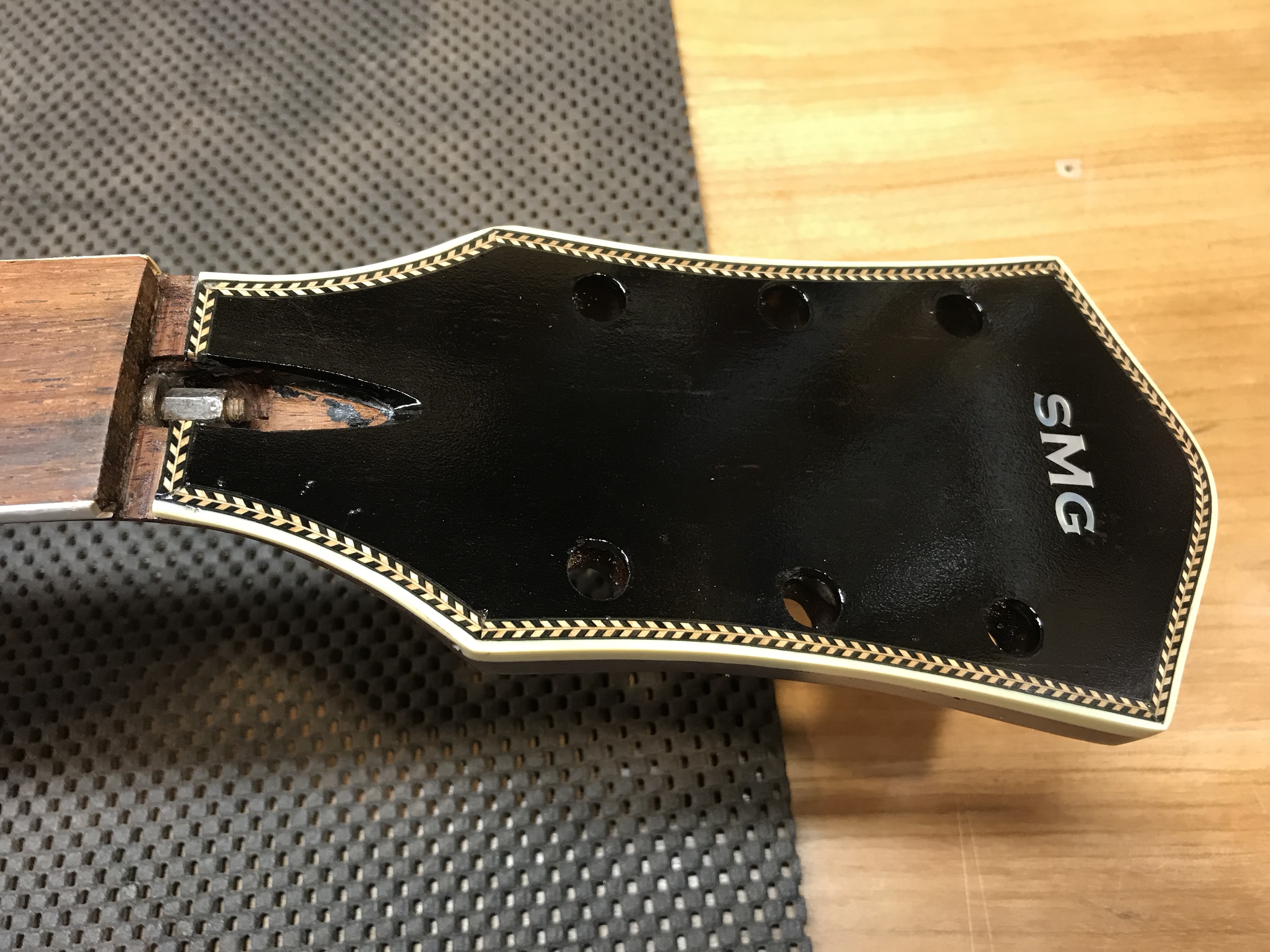
Guitar 1001 – Headstock Variations

September 1, 2010

I sent 3 options for the headstock to Steve for his approval.  Using his raven inlay design, the first option was to position the raven aligned to the top of the headstock.

100901headstock

The next two are variations of the same alignment, with the raven down between the tuners.

100901headstock1

100901headstock2

Guitar 905 – Keep the customer satisfied

July 22, 2010

I’m enrolled in a program to get my secondary mathematics certification (Those who can, do, those who can’t, teach…yeah I know I’ve heard it all before).  It has taken away time from building guitars as the homework is oppressive and the reading is double secret oppressive.

I’m progressing on guitar 1001, but in niggles and bits.  John, customer of guitar 905 has sent me a few “baby pictures”.  Pictures with babies and guitars, that is.  The guitar was dedicated to his daughter Annabelle, and here she is.

annabelle-guitar-1

Yeah, babies are cute.  Get ‘em started early, and they’ll be awesome guitarists.

Guitar 905 – Gallery

July 1, 2010

Guitar 905 photo gallery.  Headstock design came from client.

c69t1867

c69t1863

c69t1861

c69t1859

c69t1856

c69t1854

c69t1852

c69t1850

c69t1847

Guitar 906 – Gallery

July 1, 2010

Photos of Guitar 906.  Very proud of the inlay.

c69t1876

c69t1872

c69t1870

c69t1869

c69t1843

c69t1841

c69t1839

c69t1835

c69t1833

c69t1831

c69t1829

c69t1827

Guitar 905 & 906 – Ready for their closeup

June 24, 2010

Tomorrow, Tom does his photo documentation of these guitars as the final step before turning them over to their owners.  Carl picks up 906 on Saturday, and I ship 905 to John on Monday.  I have lots of time to play them before they go on their way.

100624done

100624done

100624readytoship

Sigh – Guitars 905 & 906 Complete

June 22, 2010

Well, nothing is ever really complete, but I can semi-safely say that guitars 905 and 906 are complete.  Of course there’s still that buff this and tweak that and maybe there’s a little buzz on the 7th fret second string that I could frizzle out, but oh my, they are done.

There’s a lot I can say about each, but essentially I’m very pleased with the sound.  That’s the one thing you don’t know until you finally string them up and play them.  Everything you do is directed toward how they will sound in the end (and of course how they play, but if they sound like crap, who cares how they play).  Both these guitars sound like heaven.  I’m still amazed, to this day, that you can get so much sweet sound out of a small box parlor.  It’s not a room filling volume of sound, but rather a resonant sweet tone.

The OM continues to impress me with its’ fullness and subtlety.  This guitar was walnut, and I very much like the warmth and sustain that walnut gives.

100622stringson

The parlor was my nth foray into Koa, and I am continually impressed with Koa as a guitar tonewood.  Not only does it have beautiful visual quality, but it really sings, especially in the smaller body guitars.

100622stringson

So next is to do some polishing, label installing, and playing before I send these off to their respective owners.

Oh, and some other news…..even though I build guitars, I have to support myself and my family through the concept of a day job.   I have been accepted into a program where I can get my secondary mathematics teaching certificate.  Soon, I will be a high school math teacher.

Guitar 905 – Saddle and Nut

June 15, 2010

Both the nut and saddle have been shaped in preparation for stringing up.  I need to slot the bridge pin holes for the string entrance and notch the nut for the strings.  Per the customer’s request, this is a very narrow neck at the nut.  I’m excited to see how this narrow neck feels/plays.

Guitar 906 – Bridge Mounted

June 15, 2010

After the neck set, I located the bridge position, masked off the surface and applied lacquer stripper to remove the lacquer in preparation for the bridge mounting.

100615bridgestrip

This is still a process that I’m not fully comfortable with.  As careful as one can be with the stripping of the lacquer, there is still a wee bit of contamination of the lacquer outside the area to be stripped.  This can be seen at the edge of the bridge after mounting.  It is so very slight, but still evident.  Other approaches would be to mask the box where the bridge will go prior to spraying.  Same goes for the neck/fretboard where it meets the upper bout.

Once the lacquer was removed and the surface roughed up, the bridge was glued and clamped in place.

100615bridgemount

After it cures, bridge pin holes will be drilled and tapered in preparation for setup.

Guitar 906 – Neck Installed

June 11, 2010

Carl comes to visit on the 25th.  I have been the great pretender for too long.  His guitar will be ready when he arrives.  No excuses.  I made a giant leap toward that goal today by knocking down that finish to a glorious sheen.  The buffing wheel does wonderful things.  I have learned, though, that there’s only so far that buffing wheel can hide incomplete sanding.  And, I have learned how complete I must sand in order to buff to my desired finish.

100611polishedback

I have also learned the importance of grain filling.  As I tend to finish on the light side (too much lacquer effects the sound, yet too much lacquer hides all blemishes), I can see every leftover crease, unfilled grain-ule, and divot from the sharp edge of the bench vise.  Grain filling is that step before finishing where you level off the surface with a filler, and with most tropical hardwoods, there is a bit of open grain.  Since I don’t rely on the final finish to fill the grain, I must be much more diligent in my grain filling step(s).  I will not, I repeat, I will not proceed to the finishing step until every grain has been filled and leveled.

100611polishedtop

Now, the guitar in question, Carl’s Koa Parlor, does have a very interesting “grain feature”.  The finish is not glass smooth, but accented with the natural grain of the wood.  Visually it is pleasing (unless you want glass), but tonally, it will be for the best, as the lacquer is just enough to protect, but not enough to deflect from the sound the wood wants to make.

After buffing, I dry set the neck and checked the neck angle and masked the area arount the end of the fretboard where it will be glued to the top.  The neck angle on this guitar is much closer to my preferred than any previously.  What that means is that no matter how diligent I may be determining the neck angle, after all comes together and it’s time to install the neck, it’s always a little steeper than I planned.  This guitar, a victim of multiple neck angle experiments, is much closer to ideal.

Strypeeze is used to remove the lacquer from the top where the fretboard will be glued.  The following picture is a product placement, from which I have been handsomely compensated.

Once the goop has been carefully scraped away and neutralized with water, the neck can be glued to the body.  I use a mortise and tenon bolt on neck, but the surface of the guitar top is glued to the fretboard for stability.  This means that in future neck resets, only the section of the neck attached (glued) to the top needs to be heated and relieved.

100611neckglued

Guitar 905 – Fret dressing in progress

June 10, 2010

I masked off the guitar body to avoid getting fret shavings on the finish or in the soundhole.

100610maskbody

The first opportunity is to use a file to level the frets with each other.  Fret 5 and 14 were the highest, so I filed to and between them until I started to see filing marks on the frets in between.  Next I drew the file across all 20 frets attempting to create one continuous flat surface across all frets.  Once I was close, I bevelled the ends of the frets to a 45 degree angle and removed most of the overhang for each fret.  I went back and dressed more until the frets were essentially flat.  I still had a wee bit of clearance between the straightedge and frets 1 and 2.  A quick truss rod adjustment brought those into a tolerable distance.

100610firstfretdress

I’ll dry install the nut, saddle and strings before crowning and polishing the frets.  This will allow me to set the correct string height and check for any fretting problems which need further filing.  Once (and it’s usually two or three) I have the proper setup, I can go back and crown, dress and polish the frets and install the nut and strings permanently (don’t forget to install the label after blowing out all the crap in the box Stephen!).

Install the strap peg on the heel, give it one last polish on the buffer, and this guitar will be done!

Next »