Archive for the 'Guitar Building Logs' Category

Guitar 1002 – Side Bending Underway

April 20, 2011

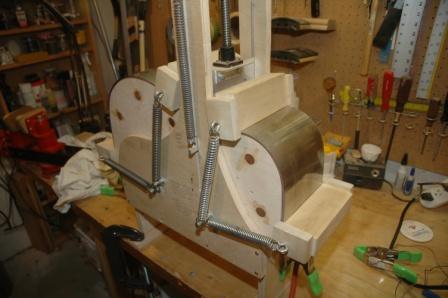
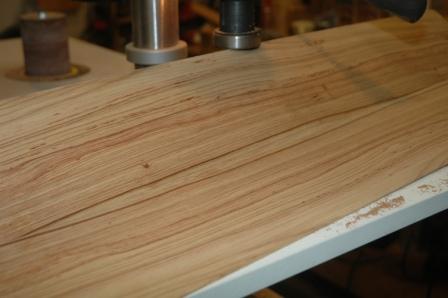
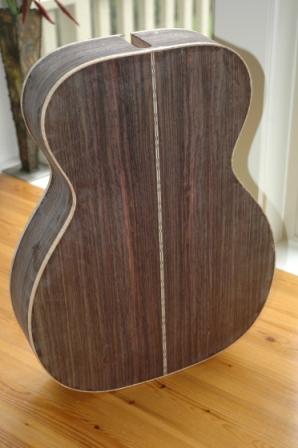
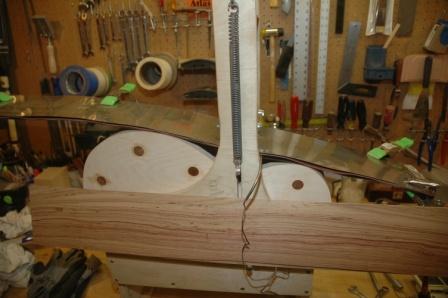
Palo Escrito is a pleasure to work with.  I first planed the sides down to about .075″ with the Safe-T-Planer then passed them through my newly repapered drum sander to smooth them and bring down to .070″.  This is very thin, but not so for a cutaway bend.  I bent the non-cutaway side first to practice bending this stuff for the first time.

110420prebend

This photo shows the setup before plunging the waist press, then drawing the spring bars down across the bouts.

110420sidebend

I’ll let this sit for a couple of hours, reheat then let sit overnight.

Guitar 1002 – Sides Planed

April 16, 2011

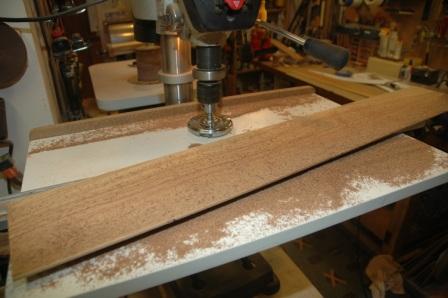
Using the same setup for planing the uke sides, I brought these sides down to .070″ in preparation for bending.

110416sideplaning

110416sidesplaned

I’m tempted to thickness the cutaway side even more, as there is a sever bend in the upper bout.  Both sides will go through the drum sander tomorrow to clean up the planer marks left behind from the Safetee Planer.

Guitar 903 and 1001 Lacquered

April 10, 2011

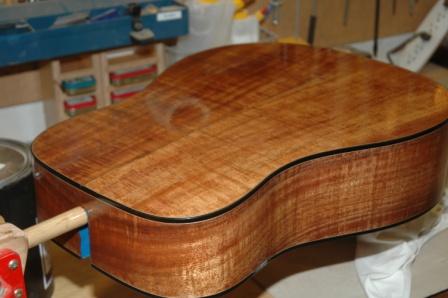
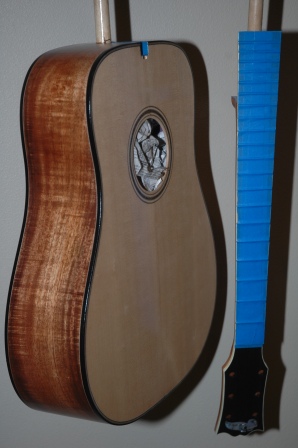
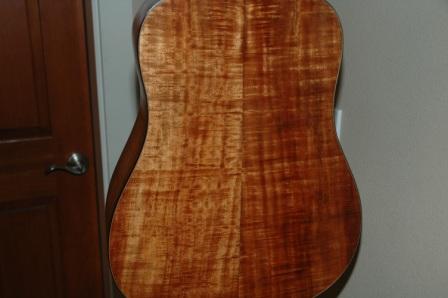
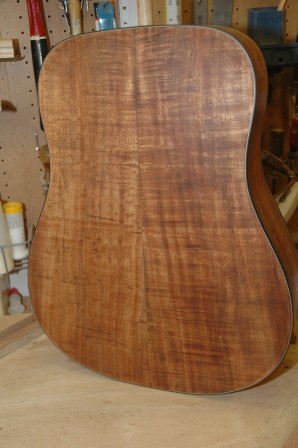
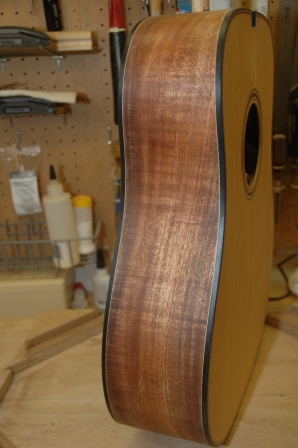
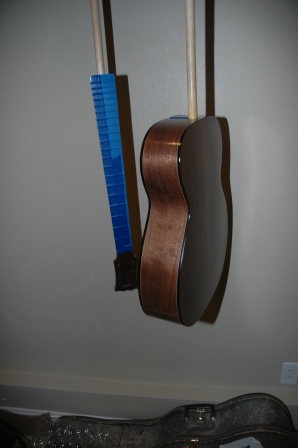
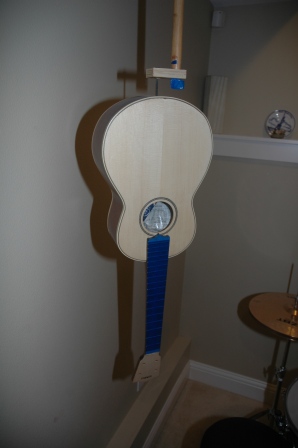
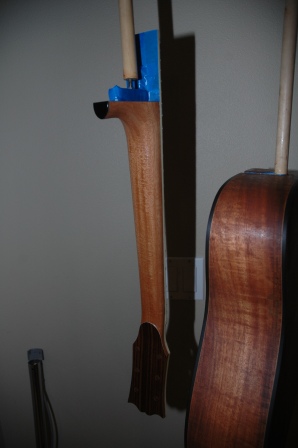
Guitar 903, the Walnut OM, and Guitar 1001, the Koa Dreadnought, have received their fair share of lacquer coats (12 to 20) and are resting for two weeks to cure.

110410lacqueredtocure

110410lacqueredbody

110410lacqueredtocure

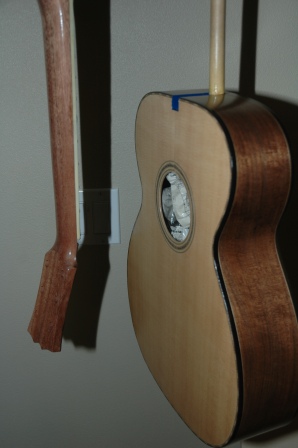
The lacquer needs at least two weeks to develop a hardness which is appropriate for the final knockdown and buffing.  Neck install, bridge install and setup will finalize.

Guitar 1002 – More Fretmarker Options

March 27, 2011

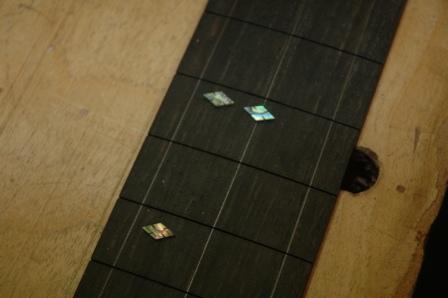
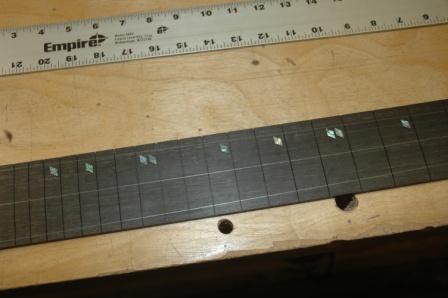
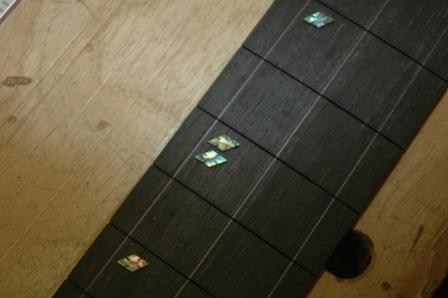
Jim asked if I could tend the fretmarkers toward the bass side.  Here are a few options.

First, markers moved left and up.

110327offsetmrk4

110327offsetmrk3

Second option is to skew the diamonds and double up on 5 and 12.

110327offsetmrk2

110327offsetmark1


Guitar 1002 – Fretboard Markers

March 20, 2011

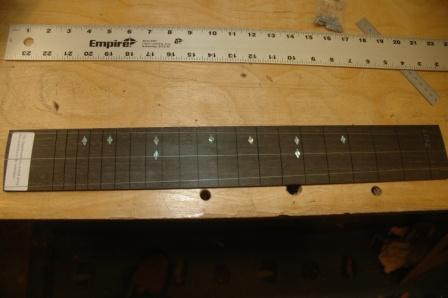
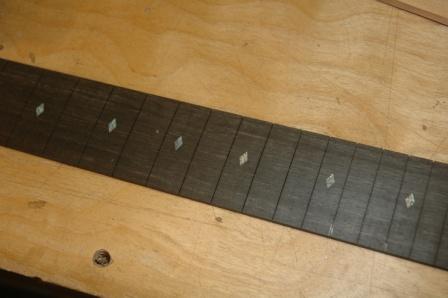
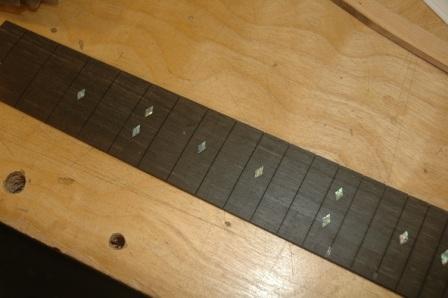
We c0ncluded that paua diamonds would be the choice for fretboard markers after the experiment with wood dots went south.  The next decision point (as simple as it may seem) is whether to go with the single marker pattern or to fancy it up a bit with double markers on 5 and 12.

110320singlediamonds

This is the single diamond configuration with markers at 3 5 7 9 12 15 and 17.

110320doubleddiamonds

This configuration simply doubles the diamonds on 5 and 12.

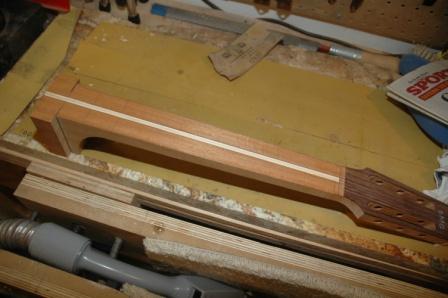
I fully tapered the neck/neck block today using my taper jig and the table saw.  Before I remove any more stock from the cutaway side of the neck block, I’ll need to know the exact dimensional thickness of the sides coming out of the cutaway.  I added the serial number to the inside of the neck block.

110320serial

What is it?

March 19, 2011

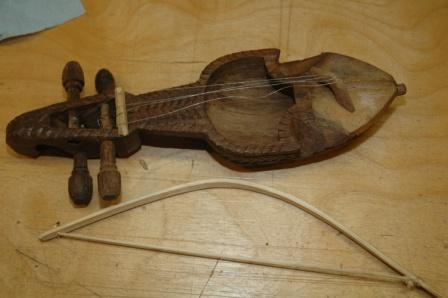
Rachel returned from China/India Tuesday and she brought me a present.

110319chinainstrument_0

She’s not sure what it’s called, so what’s it called?  I need to restring, and I’m not sure what the bridge orientation should be.

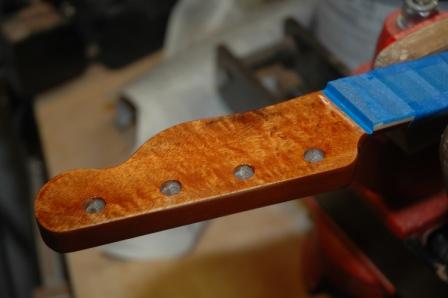
Today I added more lacquer coats to the koa dreadnought (6 of 12) and the uke (9 of 12).  The uke is a disaster.  It became dislodged from the spray booth bracket and fell to the cement causing a reasonable amount of damage, including pebbles throughout the wet lacquer coat, a chip out of the headstock, and a segment of binding with road rash.  Oh well, file it down, keep going.  Thank god this is just a “test uke”.  I’m sure it will sound lovely, but it will look like shit.

I’m also refinishing a headstock on an eBay purchased Fender koa uke.

110319fenderhead

I have some aerosol nitrocellulose that I am using to refinish this headstock.  It’s got 4 coats now, and I’ll probably go as far as 10.

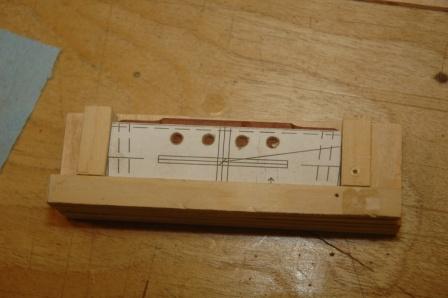
I devised a little jig for drilling holes in my uke bridges.  I’m going to use bridge pins with strings secured inside the body with bone beads.  I’ll get a picture up later of the string beads.

110319bridgejig

Guitar 1001 – 3 of 12 Lacquer Coats

March 18, 2011

Today is a day off school, so I’m spraying.  I’ve applied the 9th coat to the uke and the walnut OM, and the third coat (of 12) on the koa dreadnought.  It’s looking fine, after an exceptionally well executed pore filling step.
110318firstcoat

Guitar 1001 – Pores Filled, Ready for Lacquer

March 13, 2011

I knocked down the pore filler on the koa dreadnought.  After sanding and scraping the binding to clear off the pore filler haze, we’re ready to start the lacquer application regimen starting tomorrow.

110313backfilled

I must say, this pore filling process worked beautifully.  The surface is mirror smooth.

110313sidefilled


Spray Day – 6 of 12 and a little 3

March 11, 2011

Spray day today.  Added 3 more coats to Guitar 903, and Uke 1001 bringing them to 6.  Striving for 12.

110311sixthcoat

110311sixthcoat

Applied the first three coats to the neck for Guitar 1001 while the pore filler dries on the box.

110311thirdcoat

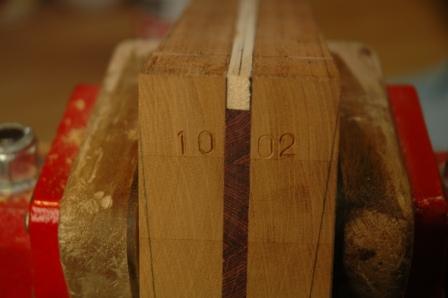
Between coats, I spent a wee bit of time inserting a temporary piece in the truss rod channel for Guitar 1002.  This is to assist in finding the centerline for the neck as I work on the taper.

110311insert

Guitar 1001 – Pore Filler Applied

March 11 , 2011

Well well well.  Dove on down to the shop, prepped the body for pore filling and dove in head first.  The back was tackled first, followed by side one then side two (A side and B side?).  First step was to apply a thick coat with a bristle brush.  Its’ consistency is somewhat like tahini.
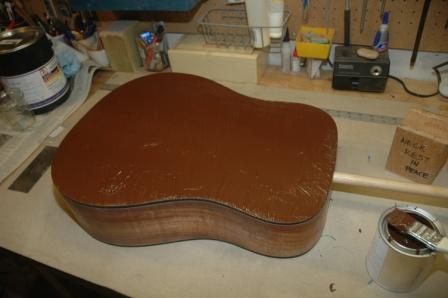
110311backappl

Or maybe, fudge brownie mix.  Next, dapple with the brush to force filler into pores.
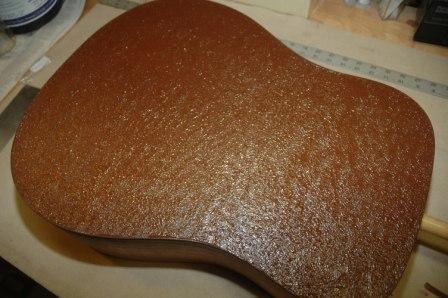
110311backdappled

Kind of reminds me of that textured ceiling spray.  I only let it sit for 5 minutes before taking the bondo scraper to it at a 45 degree angle.  It’s a bit of a messy process, and the filler tends to drool over the sides, and stray globs ended up on the top, but quick action removed the globs sufficiently.
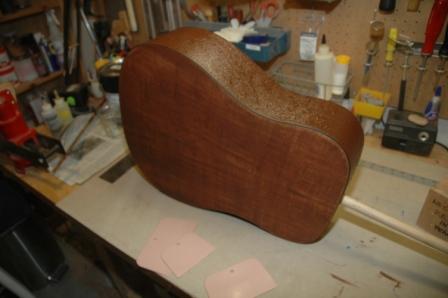
110311sideporefill

Next the sides were filled, one at a time (A and B, remember?), as the filler dries quickly, and the guitar is resting on the opposite side while applying.  Once all sides and the back were scraped clean, there was still quite a bit of filler floating on the surface.  With a shop towel (like burlap), the guitar was buffed, which removed most of the surface filler, yet kept the filled pores filled.
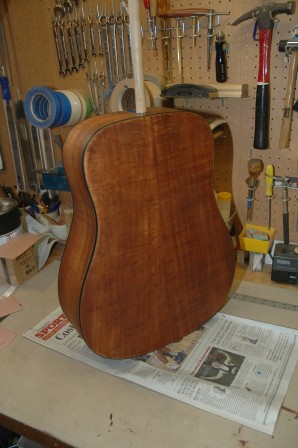
110311porefilled

After several hours of setting, I will sand off the remaining filler that still coats the surface, resulting in a resumption of the koa golds, the white purfling, and mirror smooth surface (I hope).

I am NOT going to pore fill the mahogany neck.  Or am I?  Let me think on this one for a bit.
« Prev - Next »