Guitar 0208 – Finish implies finish

July 8, 2008

Getting this guitar finished (completed) is drawing out longer and longer. Because I used a brush on water based finish, I have a surface texture full of brush lines. I don’t think it’s because of my technique, but rather the inherent issues with brushing, regardless of the claims of the product to dry smooth. I may continue using the water based lacquer, but only if I spray. I also will finish the body and the neck separately, as doing so joined, I have created a zone of undesirability in the areas where the fretboard meets the top, and the neck meets the body.

I built an adjustable workboard to hold the guitar to the workbench. This will allow me to work vigorously on the top, back, and neck as I continue to sand out the brush lines, then progressively work through finer sandpaper to arrive back at a gloss finish. I dread working the sides, as they contain the most brush lines, and I don’t yet have a proper method to secure the guitar to the workbench to address the side sanding and buffing. I’ll either work on my lap, or build a vise like the one shown here.
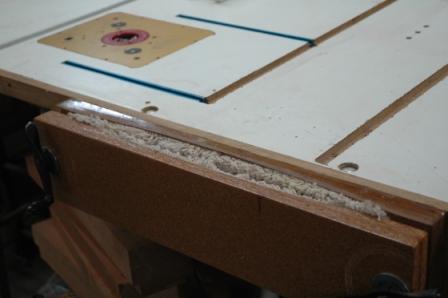
dsc_0866.jpg

I still have the issue of the chip out on the headstock to resolve, but haven’t come to a good conclusion.

Here’s where I resist my desire to cut corners or give up. I need to work in phases, making small accomplishments in the finishing process, and get to the point where I can move on to the mounting of the bridge and the string setup. I’m so close.
Guitar 0408 – Refining the mold, thinking about spreaders

July 8, 2008

With all the care and concern over getting the Parlor mold to be square and fit together such that each side mirrors the other, I still assembled a skosh off kilter.  I am using 3/8″ bolts to hold together, through 3/8″ holes.  As the left side was a bit north of the right side, I widened the holes in one side, reassembled, and got both to match perfectly before drilling a key hole in each end to accept a dowel.  Now they match, and opening and closing the mold should bring it back to it’s original orientation using the key dowels as a register.

The prebent sides fit nicely, but there is still a slight gap between the waist and the outer dimension of the bouts which I can resolve through a compression clamp, or a tighter bend in the waist.  I think I’ll try the tighter bend using my newly acquired bending iron.

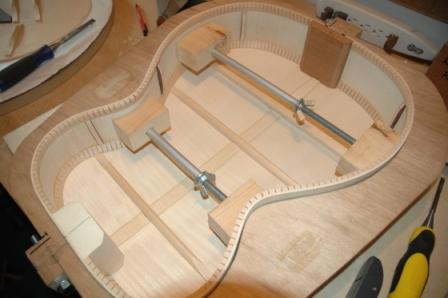
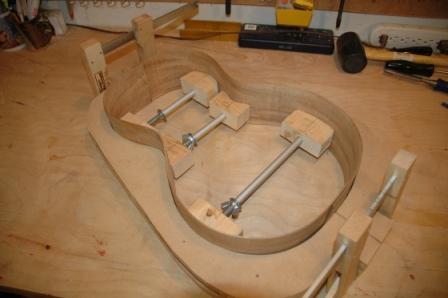
I prepared the heel block (or butt block) and realize my neck blank does not contain the dimension needed for the neck block.  I’ll have to get my hands on a piece of mahogany which is appropriate.  I also trimmed down the width of the spreader blocks, for fear I wouldn’t be able to release them from inside the Parlor body as the soundhole is smaller than my last guitars models.

I’ve scheduled an appointment with Carl and his table saw to use for squaring off the neck block in preparation for shaping the neck. 

Guitar 0408 – Making the Mold

June 29, 2008

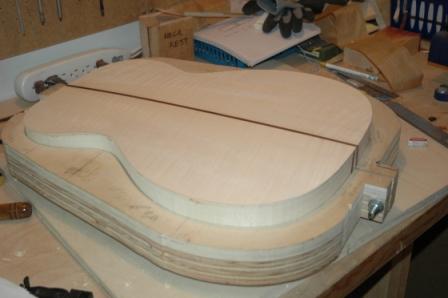
Used the free MDF from Dunn to build a mold for the Parlor.  I spent some time at the drafting board (really the ping pong table) and first made the posterboard half plate using the plans as a guide.  Then transferred to plexiglass to make a permanent half plate.  Used the plexiglass to trace on the MDF to start building the mold.

dsc_1004.jpg

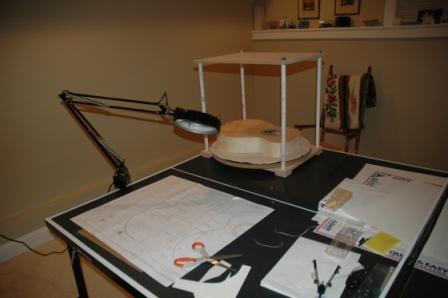
I ended up making the mold three ply, with the center section kind of a set of spacers rather than full sheet.  Was very careful to make square and to line up perfectly when adding the bolts.  Still, it’s a skosh off kilter, maybe by 1 mm.  I think that’s within my tolerances.  It looks right, and I put the sides in and the spreaders, and it will sit a bit before I get back to trimming the sides and gluing in the neck and butt block.

dsc_1005.jpg

Guitar 0408 – Building a mold

June 29, 2008

Now that the OM is out of it’s mold, and I have use of the spreaders, I’ll spend today building a mold for the Parlor so I can get the sides in and settled.

I’ll begin by making a posterboard half plate from the Plans, then transfer to plexiglass.  Once I have a plexiglass half plate I can trace out a master on MDF, cut in the band saw, then drum sand down to the exact shape.  I think I’ll go with 3 layers of 3/4″ thickness for the mold, but I might fool around with an open frame of two dowelled together.

Guitar 0308 – Back and Sides

June 28, 2008

Finished gluing on the back and sides on the Maple OM.  I also, before assembling top, routed out the truss rod channel and drilled the neck bolt holes in the neck block.  Looks good.  Next step fairing and truing the sides before I move on to binding.

Applied first set of practical knowledge from workshop by creating a posterboard template, then a plexiglass template for the headstock.  This will allow me to center my MOP on the headstock plate when gluing the veneer, and accurately locate the tuning machine holes.

Back Home

June 27, 2008

Whew.  Back from my contemporary guitar making class.  5 solid days of intense information sharing.  I’ve posted my notes and photos on the ASL page of this blog, which is password protected.

Guitar 0308 – Back attached, top bracing in progress

June 21, 2008

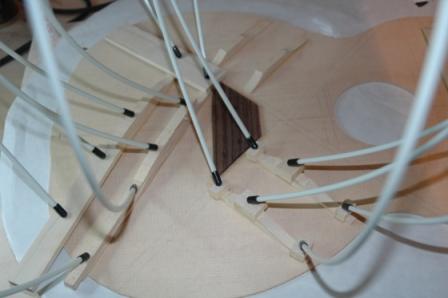
Cut down fiberglass rod stock (1/4″) to 18″ lengths to use in go bar clamping deck for attaching back and top.  Worked verrrrrry carefully to notch out kerfing on back to accept bracing.  Intentionally routed out less depth than needed, then checked and used a mini-rasp to deepen each notch as needed.  Also used glue verrrrry sparingly on kerfing.  The new rods for the go bar gave plenty of pressure, the small amount of glue held and I had no squeeze out to clean up after.

080621inside.jpg

080621backend.jpg

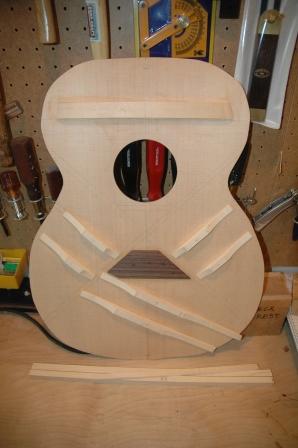
Returned to working on the top bracing.  Trimmed back the side bracing fingers to accept the X braces snugly between the bridge plate and the side braces.  Trimmed down the side braces, bringing them to a point.  Notched the flat brace at the top to leave room for the truss rod adjust and glued in the mid cross brace just above the soundhole.  This brace was drilled prior to gluing for allen wrench access to the truss rod.

080621topbrace.jpg

Preparing for ASL

June 21, 2008

Tomorrow I head off to Portland for a 5 day course called Contemporary Guitar Making.  The course is offered by the American School of Lutherie, aka, Charles Fox.  The description:  CONTEMPORARY GUITAR MAKING is a window on guitar making’s dynamic new reality. Today’s high quality guitar making is based on an accurate grasp of the acoustical behavior of the instrument and a working knowledge of the most effective means of the craft. Armed with these two things, a growing number of world class luthiers are able to systematically optimize important qualities of their guitars, and to build enough of them to both advance steadily in their craft and make a comfortable living. CONTEMPORARY GUITAR MAKING invites you to share the understanding and the techniques that make this possible.

Hmmm, world class….comfortable living….

I’m looking forward to the exposure of information and techniques, being essentially self taught to this point.  Tomorrow I pack up, and I’ll leave just after lunch to get to Portland in time to hang with my step-sister, Shannon, and her family.

Gotta pack my laptop (so I can post daily progress reports), my new Kindle (birthday present from Carol), camera (to document through photos), cell phone (to keep contact with outside world).  Funny, I’m off to learn about the world of wood and craft, yet I’m taking nothing but technology. 

Guitar 0308 – Top bracing

June 18, 2008

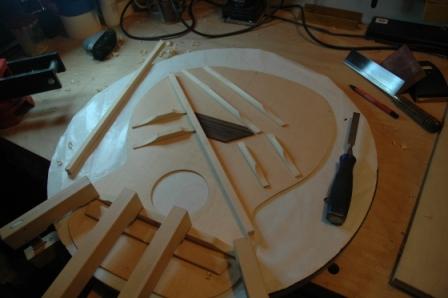
I’m applying the top braces in the order recommended in Cumpiano.  First bridge plate, then uppermost thin brace then side braces.  X brace will be last after side braces are shaped and sanded.  I shaped the tapers of the braces on the bandsaw in pairs to give exact matches of tapers on like braces.  I used a french curve to pencil in the tapers for a clean swoop.

Next, I’ll use the finger plane to crown the side braces before installing the X brace.

080616topbrace.jpg

080616topbrace1.jpg

Guitar 0208 – Final coats of lacquer

June 18, 2008

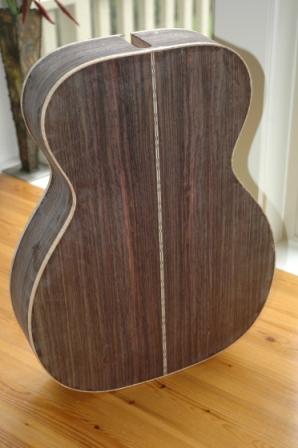
9 coats of lacquer throughout.   It’s really looking good.  Before I run off to the workshop next week, I’ll 440 sand and then decide if I need to do 3 more coats or proceed with the progressive finer sanding then buffing.

« Prev - Next »