Guitar 0308 – Radius fretboard and install kerfing

May 27, 2008

I’m doing my famous two guitars at once routine, which is actually working out quite well.  This allows me to slowly proceed on one guitar, waiting for things on it to dry/cure/settle, then move on to the second guitar and advance through it’s dry/cure/settle phase.

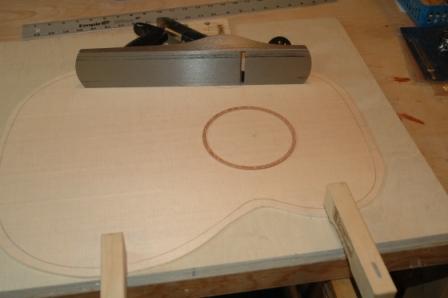
The Maple OM top sides have been sanded in the 30′ radius dish and kerfing applied.  The neck and tail block have nicely settled in from the sanding, and the kerfing process is a no brainer for me now.  Once the glue dries, I will radius sand again to bring the kerfing down flush with the sides for the top.  Then I’ll turn it over and proceed with the planing of the back sides down to the rough shape before using the 15′ radius dish for final sanding before kerfing the back.
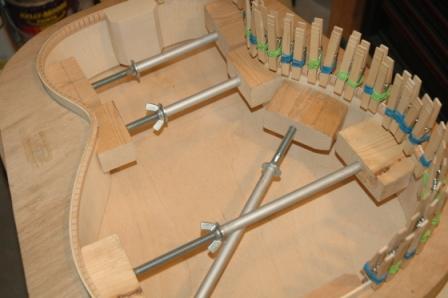
080527kerf.jpg

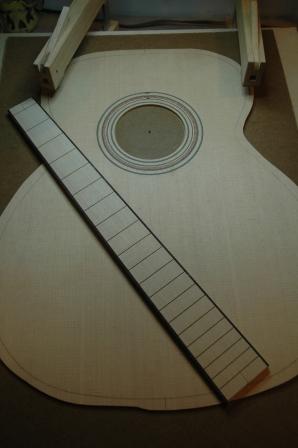
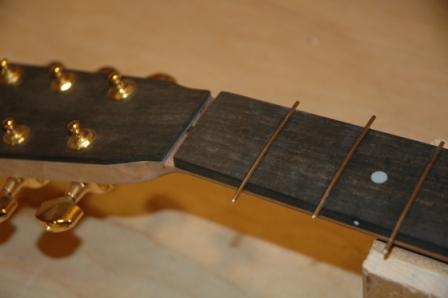
I thought it was going to be a chore to get the fretboard sanded down to the 16″ radius, but with my radius sanding block, it went fast, and it looks great.  I have ordered black plastic dots for the maple fretboard and will finish the fretboard surface with a spray lacquer (and I think before I install the frets).
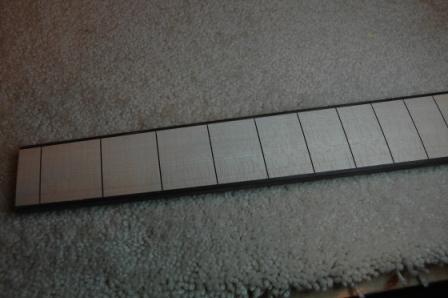
080527fretboard.jpg

Guitar 0208 – Finish

May 27, 2008

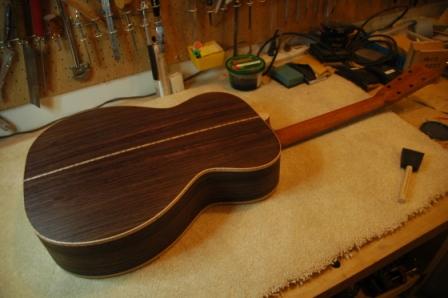
I am proceeding with the brush on lacquer process and have applied 2 coats on the entire guitar.  I got sloppy, I made streaks, I left globules, all due to haste.  I sanded back these first two coats on the back only, then applied a coat of lacquer with only a few smooth brushstrokes, applied a bit thicker than the last applications, and did the back only.  This is a test to see the results of this technique.  If appropriate, I will then do the sides, wait until dry, then repeat for the top and the neck, in that order.

080527backlacquer.jpg

Long weekend, going to SLC

May 23, 2008

Taking a few days off the craft to visit my Mom in SLC.  She just had her second titanium knee installed, and Carol and the kids and I are going to drop in to give support (even though she’s doing pretty well on her own).  I’m taking guitar 0108 along to show off to the relatives.

Spent a lot of time the past few days putting my shop back in shape.  I had a lot of scrap wood scattered around and tools lying on the bench.  I got a sharpening guide this week and spent time sharpening the chisels and plane blades.  Also crafted a jig on my stone holding board to hold the trimmed down fretboard for the OM Maple so I can easily radius sand down to the 16″ radius.  A few quick swipes with my 16″ reverse radius sanding block looks good, and I should be able to get down to the right radius quite quickly.

Good end result from the collection of scrap wood is that I have a nice set of spruce/rosewood strips to laminate up some nice side braces for the OM Maple.  I’m also ready to glue down the top braces, so all that plus the finishing routine for the OM Rosewood should keep me busy when I return from SLC

Guitar 0308 – Next step, bracing

May 21, 2008

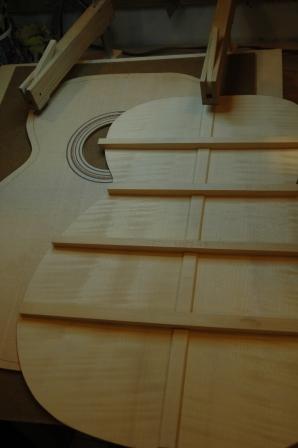
Completed the back bracing and am now ready to glue in the top bracing.  Braces are rough cut and sanded smooth.  I’ll notch and radius the X-braces and relieve end tapers and X-brace scallops with the bandsaw before gluing in.

backbraced7.jpg

Guitar 0408 – The Koa’s on backorder

May 21, 2008

I’ve place an order with LMI for a Koa back and sides, Mahogany top parlor guitar.  The Koa is the best quality figure and color available, but it’s on backorder until May 30th.  So, I don’t expect any deliveries until early June.

I’ve dropped a line to Iris, the person for whom I’m building the guitar.  Here’s the gist of my email:

Now that this looks official, I want to let you know that I am very excited about building your guitar.  I have made some design decisions which, if they come out like I imagine them, should be stunning.  My only concern is that I become quite attached to the guitars that I build, and once it’s ready for delivery, I may get a little emotional.  

I will keep you posted all through the build process.  I will document on my blog, and whenever I post an update on your guitar, I’ll send you an email prompting you to go take a look.  Also, if you are interested, I can run design decisions through you for your input.  Of course, you can always choose to allow me to take off and make all decisions myself. 

I work on several guitars at the same time.  For example, I’m finishing up a Rosewood OM guitar for myself at the same time I’m progressing with Larry’s Maple OM.  Once your materials arrive (by May 30th), I will be finished with the Rosewood and be working on Larry’s and your guitar at the same time.


I don’t know how quickly I will deliver, but it looks like around 3 months, on average, from start to finish

Guitar 0208 – Grain pore filling

May 20, 2008

I think I’ve got it down. My second attempt at filling the grain pores came out quite nice. I applied less, scraped more, and worked smaller sections. I must have thought this through in my head for most of the day and was able to carry the ideas into the shop as the application went very nicely, with a dry surface that will require little scuff sanding before i start the repeated lacquer coats.

Even though this is the second application, the pores don’t seem to be fully filled. Do I do it again, or is it acceptable? Will the lacquer coats eventually smooth out without leaving any pore indentations?

aftergrainfill.jpg

topsealed.jpg

Guitar 0308 – Rosette repair and Fretboard binding

May 20, 2008

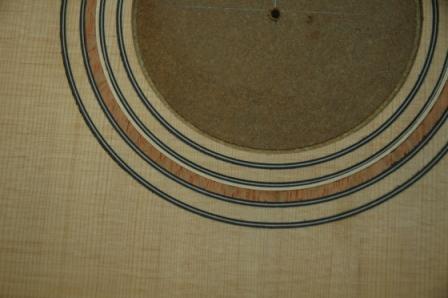
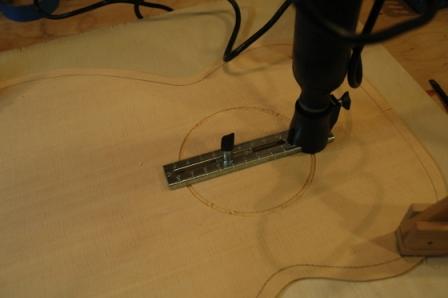
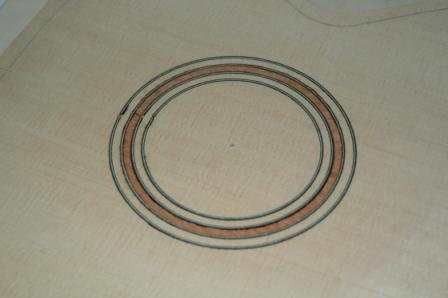
Decided to rout out a wee bit of the lacewood up to where it meets the BWB, or more accurately, where it didn’t meet the BWB. Used a 1/32″ downward spiral bit and went around twice, adjusting the diameter a skosh to open a channel to accept a two-ply maple binding strip. Aside from the fact that I almost cut through the top, and I broke off the spiral cut bit, I glued in the maple, trimmed it down, and the the end result is visually much nicer than the ragged gaps from the original lacewood BWB inlay.

rosettefixed.jpg

I cut down the unradiussed maple fretboard to the dimensions in the plans, planed the sides smooth, then relieved a small amount on each side on the band saw to allow for the attachment of rosewood binding. After planing the resawn fretboard and dry fitting the rosewood binding to the fretboard, the final dimensions were a wee bit under the plan dimensions of 43mm at the nut and 59mm at the soundhole end of the fretboard. I always seem to miss the mark on dimensioning either on the too small side (there’s no going back on this one) or way too proud (which requires massive sanding to bring down to size). Ideally, in the future, all my cuts will result a wee bit proud, requiring minimal sanding to arrive at the final dimension. I think this is like practicing a lick over and over again until you have it nailed.

fretboard.jpg

Guitar 0208 – Finishing

May 19, 2008

I’ve embarked on an alternative finishing approach for my second guitar.  First guitar, I used a spray on nitrocellulose lacquer which forced me outside and reeked of banana souffle.  I was introduced to a brush on lacquer (water based) called KT9, which I got from LMI. 

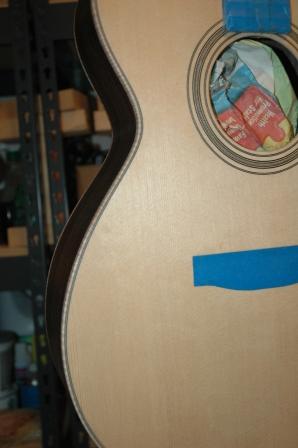
I sanded the guitar in preparation for finishing and applied a sanding sealer coat of KT9 diluted to 50%.  Amazingly, this stuff has NO odor.  The sealer coat went on marvelously, and I only created a few unsightly dribbles across the waist.  Before sealing, I applied a 5 part tobacco to 1 part red stain to the mahogany neck.  As careful as I was to mask, I bled through slightly onto the maple veneer on the headstock.

The next step after sanding sealer is the grain pore filler.  I botched it terribly.  It’s hard to work with, leaves streaks on the surface, and I over did it on application.  I slept poorly last night obsessing on what I did wrong.  Books suggest the pore sealer usually takes two coats, and I think I know what to do to improve this process for the second coat.  I will apply in stages, back, sides, top, neck, with significant wait time between each stage, and apply very thin amounts, carefully scraping off all surfaces before it dries to leave only sealed pores, allowing light sanding to get back to the wood surface.  As it is, I have left myself a monster sanding job to get the grain sealer off the surface of the wood.

Even though I practiced on scrap, it doesn’t give you the pacing practice for larger surfaces, which only comes with applying to the real thing. 

Guitar 0208 – Nut

May 17, 2008

Today I will finish trimming up the frets, filing down the fret ends flush with the fretboard, and bevelling the fret ends.  Even though the neck is pretty straight and most of the frets are straight along the neck length, I will do a tiny bit of fret levelling with a mill file.

Once that is complete, I will begin the finish process:  clean, clean, clean, sand, scrape, sand, sand, sand, clean.

The topic “nut” refers to the bone nut between the headstock and the end of the fretboard.  I’m using a preshaped bone nut which has a bevel on the bottom whereas my channel is flat.  I inserted and glued a small piece of mahogany to bring the channel up flush with the nut.

fretson6.jpg

Guitar 0308 – Rosette

May 17, 2008

First opportunity to install my own rosette.  Larry and I decided on using a lacewood ring as the centerpiece of the rosette for his OM Maple.  Carefully reviewed all DVD and book instructions and discussion about coating top with shellac to reduce tearout also claimed using a good spiral cut bit would preclude having to shellac.

As I have a lot of sanding to do to get the shellac off the Rosewood OM spruce top, I decided to forego the shellac and rout the channels raw.  I channelled the center slot for the lacewood first, glued and inlaid it in anticipation of routing the outer and inned channels flush against the lacewood for the BWB.

rosetteprep.jpg

Clever, I thought, but I routed the inner channel slightly proud of the lacewood leaving a minute bit of spruce between the lacewood and the BWB.  I won’t know if this is visually yucky until I scrape down, sand, and finish.

rosetteprep3.jpg

Was very careful not to rout too deep as that error can result in going through the top.  The converse though creates a lot of work scraping and sanding down the purfling flush with the top.

rosetteinlaid.jpg

The end result looks good, but we’ll see.  Next, scrape, sand, then cut out soundhole.

« Prev - Next »